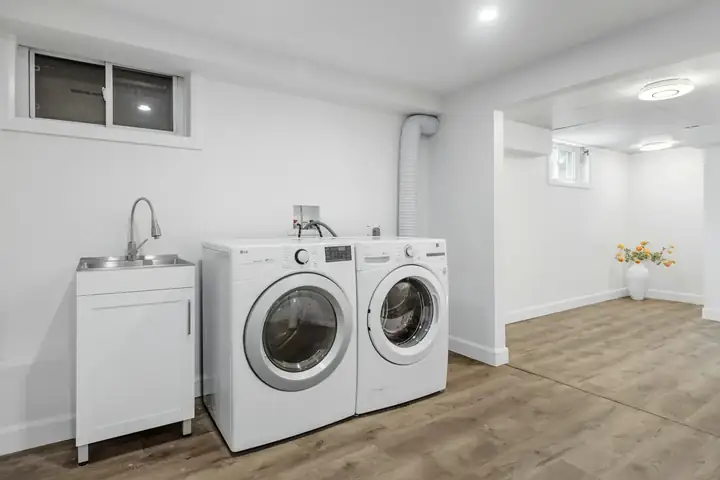
When a Home Needs a New Dryer Vent
Repair fixes a vent that already runs to the right place. Installation starts over: a new route, new duct and usually a new opening in an outside wall or the roof. These are the jobs that call for it.
| Situation | What the installation involves |
|---|---|
| Laundry moved to a new room or floor | A new route from the new spot to the nearest outside wall or the roof |
| Basement being finished | Running and sealing the duct before drywall hides it |
| First dryer in the house | A complete vent, outlet hood included |
| Run too long for the dryer | A shorter route with fewer elbows |
| Foil or plastic duct inside a wall | Replacing it with 4-inch smooth metal duct |
If the vent already reaches a good outlet and only one part failed, the dryer vent repair page covers the smaller job.
Dryer Vent Installation Cost
Route and length set most of the price. A dryer against an outside wall needs a few feet of duct and one hole. A dryer on the second floor of a townhome can need a long run through a ceiling and a roof outlet. Patching drywall or siding afterward is often quoted separately, so ask whether it's included.
| Job | Typical cost |
|---|---|
| New vent straight through an exterior wall | $150–$300 |
| Replacing an existing vent line on the same route | $100–$300 |
| Installed duct, 8 ft / 20 ft / 35 ft | About $110 / $210 / $290 |
| Long run from an upper floor | About $1,000 |
| Drywall patching after the walls are opened | $300–$950 |
| Siding repair around a new outlet | $350–$1,500 |
Most installations land between $140 and $600, about $200 on average. These are U.S. national figures; Northern Virginia quotes often run higher, so use them to judge a quote rather than to predict it. A written estimate for your house settles the number.
Sources: Angi, dryer vent installation cost (updated September 10, 2026); HomeAdvisor, dryer vent installation cost (updated June 17, 2026). U.S. national ranges, not a quote.
What Virginia Code Requires of a New Dryer Vent
Section M1502 of the 2021 Virginia Residential Code sets the rules. A new installation is the easiest time to meet all of them, because nothing is hidden yet.
| Part | Requirement |
|---|---|
| Exhaust duct | 4-inch nominal, smooth interior, metal at least 0.0157 inch thick (No. 28 gage) |
| Joints | Sealed and mechanically fastened; no screws poking more than 1/8 inch into the duct |
| Support | At intervals of 12 feet or less |
| Length | 35 feet minus fitting allowances, or the length the dryer maker's instructions allow |
| Long-run label | Over 35 feet equivalent length, a permanent label within 6 feet of the duct connection |
| Transition duct | One length listed to UL 2158A, 8 feet or less, never concealed |
| Outlet | Outside the building, with a backdraft damper and no screen |
When the new duct runs inside a wall or ceiling, the code expects an inspection before it's covered. The inspector asks for the dryer's installation instructions at that visit. Ask the installer whether your job needs a Loudoun County permit.
Options Price Guides List That Virginia Code Doesn't Allow
National cost guides price PVC, plastic and slim ducts, indoor vent boxes and booster fans alongside metal duct. Some of those are cheaper for a reason. For the exhaust duct itself, several aren't allowed in a Virginia home at all.
| Option | Allowed? | Why |
|---|---|---|
| PVC or plastic exhaust duct | No | The exhaust duct has to be metal |
| 3-inch duct | No | The code calls for 4-inch nominal |
| Foil or vinyl hose inside a wall | No | The transition hose may never be concealed |
| Indoor vent box for a vented dryer | No | Dryer exhaust has to end outside the building |
| Screen over the outdoor hood | No | Screens catch lint and block the outlet |
| Domestic booster fan in the duct | No | Banned in dryer exhaust systems |
| Dryer exhaust duct power ventilator | Yes | Only a unit listed to UL 705, installed per its instructions |
A quote that includes any of the first six is a quote to redo later. Ask what duct the installer plans to use before you compare prices.
Wall or Roof: Where the New Vent Should Exit
A wall outlet is the default choice. The run is shorter, the hood is reachable for cleaning, and there's no roof to open. A roof outlet makes sense when the laundry sits in the middle of the house, which is common in Dulles-area townhomes, and every wall route would exceed the length limit.
Wall Outlet
- Shorter run, lower price
- Hood reachable for cleaning
- Easy to check the damper opens
- Needs an outside wall within reach
Roof Outlet
- Longer run, more elbows
- Harder to clean and inspect
- Needs a roof cap made for dryer exhaust
- Often needs HOA sign-off in townhome communities
Townhome owners should check the association's rules on new exterior openings before work starts; the townhome and HOA vent guide covers what to ask.
How to Compare Dryer Vent Installation Quotes
Two quotes can differ by hundreds of dollars and describe the same job, or match on price and describe very different ones. Ask each installer the same questions.
- Duct: 4-inch smooth metal for the whole concealed run?
- Route: total length and number of elbows, checked against 35 feet or the dryer maker's figure?
- Outlet: a hood with a backdraft damper and no screen?
- Patching: drywall and siding repair included, or separate?
- Proof: an airflow check at the outlet when the job is done?
- Licence: Virginia requires a Class C contractor licence for jobs over $1,000 and under $30,000, and a written contract for residential work.
Once the new vent is in, it still collects lint; the dryer vent cleaning page covers how often a new run needs attention.